

How To Clean Backside After Bowel Movement
Anal hygiene [ane] or anal cleansing [2] refers to hygienic practices that are performed on a person's anus, normally presently after defecation. Post-defecation cleansing is rarely discussed academically,[two] partly due to the social taboo. The scientific objective of mail service-defecation cleansing is to foreclose exposure to pathogens[two] while socially it becomes a cultural norm. The process of post-defecation cleansing involves either rinsing the anus and inner part of the buttocks with water or wiping the area with dry out materials such as toilet newspaper. In water-based cleansing either a hand is used for rubbing the area while rinsing it with the help of running water or (in bidet systems) pressurized water does the chore. In either method subsequent hand sanitization is essential[2] to achieve the ultimate objectives of post-defecation cleansing.
Cultural preferences [edit]
Culture is defined as learned behavior which has been socially acquired.[iii] Culture is the shared and organized trunk of customs, skills, ideas and values, transmitted socially from one generation to another. Health behavior and culture are interconnected. It lays down norms of behavior and provides mechanisms which secures for an individual, their personal and social survival.[three] In predominantly Catholic countries,[4] Eastern Orthodox,[5] Hindu, Buddhist and Muslim cultures, and in some Protestant countries such as Republic of finland,[6] likewise as in Southeast Asia and Southern Europe and Latin America,[seven] water is usually used for anal cleansing, using a jet (bidet shower, bidet) or vessel (lota, aftabeh), and a person'due south hand (in some places only the left hand is used). Cleaning with h2o is sometimes followed past drying the anal region and manus with a fabric towel or toilet newspaper. On the other hand, in some parts of developing countries and during camping trips, materials such every bit vegetable matter (leaves), mudballs, snow (water), corncobs, and stones are sometimes used for anal cleansing.[8] [ix] Having aseptic ways for anal cleansing available at the toilet or site of defecation is important for overall public health. The absenteeism of proper materials in households can, under some circumstances, be correlated to the number of diarrhea episodes per household.[ten] The history of anal hygiene, from ancient Rome and Greece to China and Japan, involves sponges and sticks as well every bit water and paper.
The inclusion of anal cleansing facilities is oftentimes overlooked when designing public or shared toilets in developing countries. In most cases, materials for anal cleansing are not made available within those facilities. Ensuring condom disposal of anal cleansing materials is often overlooked, which can lead to unhygienic debris within or surrounding public toilets that contributes to the spread of diseases.[11]
Post-defecation facilities evolved with human being civilisation, thus, postal service-defecation cleansing. Co-ordinate to Fernando [12] there are Sri Lankan archeological evidences of toilet employ ranging from 936 Advertisement at Pamsukulika monastery in Ritigala, sixth century Abhayagiri circuitous in Anuradhapura and at the Baddhasimapasada and the Alahana Pirivena hospital complex in Polonnaruwa to 12th century infirmary toilet in Mihintale.[ citation needed ] These toilets were plant to be with a complete system of plumbing and sewage with multistage treatment plants. According to Buddhism, toilet etiquettes (Wachchakutti Wattakkandaka in Pali language) were enumerated by Buddhas himself in Tripitaka (Three baskets), also known as Pali Canon, the earliest collection of Buddhist teachings.[ citation needed ]
Common methods [edit]
Water [edit]


H2o with soap cleansing is a reliable and aseptic mode of removing fecal remnants.
Muslim societies [edit]
The use of water in Muslim countries is due in part to Islamic toilet etiquette which encourages washing afterwards all instances of defecation.[xiii] There are flexible provisions for when h2o is scarce: stones or papers can be used for cleansing after defecation instead.
In Turkey, all Western-style toilets have a small-scale nozzle on the centre rear of the toilet rim aiming at the anus. This nozzle is chosen taharet musluğu and it is controlled by a small tap placed inside manus'southward reach near the toilet. Information technology is used to launder the anus after wiping and drying with toilet newspaper. Squat toilets in Turkey do not take this kind of nozzle (a modest bucket of water from a paw'due south reach tap or a bidet shower is used instead).
Another alternative resembles a miniature shower and is known as a "health faucet", bidet shower, or "bum gun". It is commonly found to the right of the toilet where it is easy to accomplish. These are commonly used in the Muslim globe. In the Indian subcontinent, a lota vessel is often used to cleanse with water, though the shower or nozzle is mutual amongst new toilets.
Indian subcontinent [edit]
In Republic of india and the Indian subcontinent, over 95% of the population utilise water for cleansing the anal area after defecating. The cleaning of easily with soap/ liquid soap after this cleansing process is very important. In urban areas and newer settlements bidet showers are widely used. Simpler toilet rooms or toilets in places without abiding supply of running water generally use a lota or a mug along with buckets, and bails for storage of water and for the purpose of cleaning.
Southeast Asia [edit]
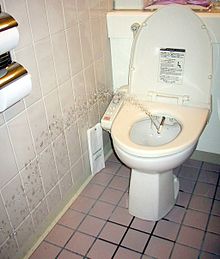
A Japanese toilet with integrated bidet spraying water for cleaning. The h2o jet is used to wash the anus and buttocks after defecation.
In Southeast Asian countries such as Indonesia, the Philippines,[14] Thailand, Negara brunei darussalam, Malaysia, and Democratic republic of timor-leste,[15] house bathrooms commonly take a medium size wide plastic dipper (called gayung in Indonesia, tabo in the Philippines, ขัน (khan) in Thai) or big loving cup, which is too used in bathing. In Thailand, the "bum gun" is ubiquitous.[16] Some health faucets are metal sets attached to the bowl of the water closet, with the opening pointed at the anus. Toilets in public establishments mainly provide toilet paper for gratuitous or dispensed, though the dipper (often a cutting up plastic canteen or pocket-size jug) is occasionally encountered in some establishments. Owing to its ethnic diverseness, restrooms in Malaysia often characteristic a combination of anal cleansing methods where almost public restrooms in cities offer toilet paper likewise every bit a built in bidet or a small hand-held bidet shower (health faucets) connected to the plumbing in the absence of a built-in bidet.
In Vietnam, people often use a bidet shower.[17] [sixteen] Information technology is usually bachelor both at general households and public places.
East asia [edit]
The commencement "paperless" toilet seat was invented in Nippon in 1980. A spray toilet seat, commonly known by Toto's trademark Washlet, is typically a combination of seat warmer, bidet and drier, controlled by an electronic panel or remote command adjacent to the toilet seat. A nozzle placed at rear of the toilet basin aims a water jet to the anus and serves the purpose of cleaning. Many models accept a separate "bidet" function aimed towards the front for feminine cleansing. The spray toilet seat is mutual just in Western-mode toilets, and is not incorporated in traditional style squat toilets. Some modern Japanese bidet toilets, particularly in hotels and public areas, are labeled with pictograms to avoid language problems, and most newer models have a sensor that will pass up to activate the bidet unless someone is sitting on the toilet.

Europe and the Americas [edit]
The use of h2o in many Christian countries is due in part to the biblical toilet etiquette which encourages washing later all instances of defecation.[18] The bidet is common in predominantly Catholic countries where water is considered essential for anal cleansing,[19] [20]
Some people in Europe and the Americas use bidets for anal cleansing with water. Bidets are mutual bath fixtures in many Western and Southern European countries and many S American countries,[21] [22] [23] while bidet showers are more common in Finland,[24] and Greece. The availability of bidets varies widely within this group of countries. Furthermore, even where bidets exist, they may have other uses than for anal washing. In Italian republic, the installation of bidets in every household and hotel became mandatory past law on July 5, 1975.[22]
Toilet paper [edit]
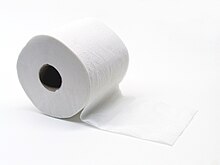
In some cultures—such equally many Western countries—cleaning subsequently defecation is more often than not done with toilet paper only, until the person tin can bathe or shower. Toilet paper is considered a very important household commodity in Western culture, equally illustrated by the panic ownership of toilet paper in many Western countries during the COVID-xix pandemic.[25] [26]
In some parts of the earth, peculiarly before toilet paper was bachelor or affordable, the utilize of newspaper, phone directory pages, or other newspaper products was common. In North America, the widely distributed Sears Roebuck catalog was also a popular choice until it began to be printed on glossy paper (at which point some people wrote to the visitor to complain).[27] [28] With flush toilets, using newspaper as toilet paper is likely to cause blockages.
This practice continues today in parts of Africa; while rolls of toilet paper are readily available, they tin exist fairly expensive, prompting poorer members of the customs to apply newspapers.
People suffering from hemorrhoids may detect it more than difficult to keep the anal expanse clean using merely toilet paper and may prefer washing with h2o too.[29] [ citation needed ]
Although wiping from front to back minimizes the risk of contaminating the urethra, the directionality of wiping varies based on sex, personal preference, and culture.
Some people wipe their anal region standing, others wipe theirs sitting.[30]
Other methods and materials [edit]
Wet wipes and gel wipes [edit]
When cleaning babies' buttocks during diaper changes moisture wipes are often used, in combination with water if bachelor. Equally wet wipes are produced from plastic textiles made of polyester or polypropylene, they are notoriously bad for sewage systems as they do not decompose, although the wet wipe manufacture maintains they are biodegradable but not "flushable".[31] [32] [33]
A product of the 21st century, special foams, sprays and gels tin can be combined with dry toilet paper equally an alternatives to wet wipes. A moisturizing gel tin exist applied to toilet paper for personal hygiene or to reduce peel irritation from diarrhea. This product is called gel wipe.[34]
Prewipes [edit]
Novel pre-wipes and methods are disclosed for assisting in the cleaning of skin in the anal area. The pre-wipes comprise an anti-adherent conception and are wiped beyond the anal region of a user prior to defecation to introduce a moving picture of the anti-adherent formulation onto the anal region. This film reduces the amount of fecal material that is retained in the anal region later on defecation and reduces the corporeality of cleanup required. This reduced corporeality of cleanup results in cleaner, healthier skin.[35]
Natural materials [edit]
In rural areas of developing countries or during camping trips, stones, leaves, corn cobs and like are also used for anal cleansing.[nine] : 162 This tin be due to the unavailability of toilet paper or water.
Examples by region or country [edit]
- In East Asian, Western and multicultural societies, the Chinese-mode apply of toilet paper is widespread. Other paper products were besides used before the appearance of flush toilets.
- Some European and Southward American countries use a bidet for additional cleaning.[7]
- In modernistic S Asia and Southeast Asia, handheld bidets or bidet showers are provided for use in toilets.
- Toilets in Japan may include congenital-in bidets for anal cleansing with warm water.
- In the Indian subcontinent, traditionally cleansing was done by using the left manus and water. Later the hands are washed thoroughly with water and soap.
History [edit]

Anal cleansing instruments known as chūgi from the Nara period (710 to 784) in Japan. The mod rolls in the groundwork are for size comparison.[ane]
Ancient Greeks were known to use fragments of ceramic known as pessoi to perform anal cleansing.[36]
Roman anal cleansing was done with a sponge on a stick called a tersorium (Greek: xylospongium). The stick would be soaked in a water channel in front of a toilet, and and so stuck through the hole in front of the toilet[37] [ clarification needed ] for anal cleaning.[38] [39] The tersorium was shared by people using public latrines. To clean the sponge, they washed it in a bucket with water and salt or vinegar. This became a breeding ground for bacteria, causing the spread of affliction in the latrine.
In aboriginal Japan, a wooden skewer known equally chuugi ("shit sticks") was used for cleaning afterward defecation.
The use of toilet paper for post-defecation cleansing first started in China in the 2d century BC.[one] [xl] According to Charlier (2012) French novelist (and physician) François Rabelais had argued virtually the ineffectiveness of toilet paper in the 16th century.[1] The first commercially available toilet paper was invented by a New York entrepreneur named Joseph Gayetty in 1857 with the dawning of the 2nd industrial revolution.[41]
See also [edit]
- Gel wipe, moisturizing gel practical to dry out toilet paper
- Oshibori, reusable Japanese wet paw towel
- Washlet, mechanical alternative to moisture wipes
- Moisture wipe
References [edit]
- ^ a b c d Charlier, Philippe; Brun, Luc; Prêtre, Clarisse; Huynh-Charlier, Isabelle (17 December 2022). "Toilet hygiene in the classical era". BMJ. 345: e8287. doi:10.1136/bmj.e8287. ISSN 1756-1833. PMID 23247990. S2CID 43471110.
- ^ a b c d McMahon, Shannon; Caruso, Bethany A.; Obure, Alfredo; Okumu, Fred; Rheingans, Richard D. (2011). "Anal cleansing practices and faecal contamination: a preliminary investigation of behaviours and conditions in schools in rural Nyanza Province, Kenya". Tropical Medicine & International Health. 16 (12): 1536–1540. doi:10.1111/j.1365-3156.2011.02879.10. ISSN 1365-3156. PMID 21906214. S2CID 205392366.
- ^ a b Patel, Mihir; Phillips-Caesar, Erica; Boutin-Foster, Carla (1 October 2022). "Barriers to Lifestyle Behavioral Change in Migrant South Asian Populations". Periodical of Immigrant and Minority Health. 14 (v): 774–785. doi:10.1007/s10903-011-9550-x. ISSN 1557-1920. PMC4666510. PMID 22180198.
- ^ E. Clark, Mary (2006). Gimmicky Biological science: Concepts and Implications. University of Michigan Press. p. 613. ISBN9780721625973.
Douching is normally expert in Cosmic countries. The bidet ... is withal commonly plant in French republic and other Catholic countries.
- ^ Due east. Clark, Mary (2006). Contemporary Biological science: Concepts and Implications. Academy of Michigan Press. p. 633. ISBN9780721625973.
- ^ "Bidets in Finland"
- ^ a b c Roberto Zapperi: Zu viel Moralismus macht den Körper schmutzig., in: FAZ, 24 aprile 2022.
- ^ Eds.; Simpson-Hébert, co-authors: Uno Winblad, Mayling (2004). Ecological sanitation (2nd rev and enlarged ed.). Stockholm: Stockholm Environment Constitute. p. 67. ISBN9188714985.
- ^ a b Tilley, Elizabeth; Ulrich, Lukas; Lüthi, Christoph; Reymond, Philippe; Zurbrügg, Chris (2014). "Septic tanks". Compendium of Sanitation Systems and Technologies (2nd ed.). Duebendorf, Switzerland: Swiss Federal Institute of Aquatic Science and Technology (Eawag). ISBN978-3-906484-57-0.
- ^ Herbst, S. (2006). Ecology and development series No. 43, 2006 – Water, sanitation, hygiene and diarrheal diseases in the Aral Body of water area. PhD thesis, Göttingen: Cuvillier Verlag
- ^ McMahon, Shannon; Caruso, Bethany A.; Obure, Alfredo; Okumu, Fred; Rheingans, Richard D. (2011). "Anal cleansing practices and faecal contamination: a preliminary investigation of behaviours and conditions in schools in rural Nyanza Province, Kenya". Tropical Medicine & International Health. 16 (12): 1536–1540. doi:10.1111/j.1365-3156.2011.02879.x. ISSN 1365-3156. PMID 21906214. S2CID 205392366.
- ^ Fernando, Wickramarachchige Sugath Rohitha. An Examination of the Relationship Betwixt Acculturative Stress and Lack of Facilities for Use of Water for Post Defecation Cleansing Among Sinhala Sri Lankan Immigrants in Australia, Canada and Usa. A Dissertation Presented to the Dissertation Committee of the Higher of Health Sciences of Trident University International in Partial Fulfillment of the Requirements for the Degree of Medico of Philosophy in Health Sciences. Past Wickramarachchige Sugath Rohitha Fernando. Cypress, California, 2022. https://www.researchgate.net/publication/338717444_Fernando_Final_dissertataion_2-6-2017_-_Copy_1
- ^ Fataawa al-Lajnah al-Daa'imah: 259 Archived one February 2009 at the Wayback Machine. accessed 29 June 2008
- ^ Benedict, Paul Chiliad. (1975). Austro-Thai language and civilization, with a glossary of roots. HRAF Press. p. 271. ISBN9780875363233 . Retrieved eleven March 2022.
- ^ Malasig, Jeline (7 November 2022). "A foreign blogger's fascination with the 'coolest Filipino household item'". Interaksyon. Archived from the original on 10 November 2022. Retrieved 10 November 2022.
- ^ a b Nguyen-Okwu, Leslie (9 May 2022). "Merchandise the Toilet Newspaper for a Bum Gun". Yahoo News . Retrieved 15 August 2022.
- ^ "Bạn sẽ không nhìn thấy vòi xịt toilet khi đến Mỹ – vì sao vậy?" (in Vietnamese). 15 August 2022.
- ^ E. Clark, Mary (2006). Contemporary Biology: Concepts and Implications. University of Michigan Press. ISBN9780721625973.
- ^ E. Clark, Mary (2006). Contemporary Biological science: Concepts and Implications. University of Michigan Press. p. 613. ISBN9780721625973.
Douching is commonly skillful in Catholic countries. The bidet ... is still usually found in France and other Catholic countries.
- ^ Made in Naples. Come up Napoli ha civilizzato l'Europa (e come continua a farlo) [Made in Naples. How Naples civilised Europe (And however does it)] (in Italian). Addictions-Magenes Editoriale. 2022. ISBN978-8866490395.
- ^ (in French) L'historique du papier toilette et du bidet
- ^ a b Decreto ministeriale Sanità, 5 July 1975, art. 7.
- ^ Decreto-Lei northward.º 650/75 de 18 de Novembro (in Portuguese), eighteen November 1975, fine art. 84
- ^ "A hose: Always next to every Finnish toilet – Big in Finland". eight July 2022.
- ^ "How the Coronavirus Created a Toilet Paper Shortage". Higher of Natural Resources News. 19 May 2022. Retrieved 3 January 2022.
- ^ Güzel, Aziz (2 July 2022). "A brief reflection on losing and finding toilet newspaper". Psychodynamic Practice. 26 (3): 215–220. doi:10.1080/14753634.2020.1759290. ISSN 1475-3634. S2CID 219000146.
- ^ Adams, Cecil (xv August 1986). "What did people apply before toilet paper was invented?". The Straight Dope . Retrieved 29 Baronial 2022.
- ^ Rodriguez, Linda (viii July 2009). "Why toilet paper belongs to America". CNN . Retrieved 29 August 2022.
- ^ Publishing, Harvard Health (24 April 2022). "Hemorrhoids". Harvard Health . Retrieved 3 January 2022.
- ^ Baragona, Louis (29 August 2022). "Apparently Barrel-Wiping Is a Heated Debate". Men's Health . Retrieved 27 July 2022.
- ^ Pajda, Aleksandra (7 May 2022). "Did You Know Wet Wipes Are Made With Plastic? This Is Why the UK Wants Them Banned". Ane Green Planet.
- ^ "Wet wipes could face wipe-out in plastic clean-up". BBC News. eight May 2022. Retrieved 15 Baronial 2022.
- ^ Campbell, Emma (xiii November 2022). "No 'flushable' wet wipes tested then far pass h2o industry tests". BBC News . Retrieved 15 August 2022.
- ^ "Toilet Paper Gel Cleans Upwards No. 2 in More than Ways Than One". Forbes.
- ^ [1], "Pre-wipes for improving anal cleansing", issued 2004-04-thirty
- ^ Mirsky, Steve. "Toilet Issue: Anthropologists Uncover All the Ways We've Wiped". Scientific American (i March 2022). doi:ten.1038/scientificamerican0313-85.
- ^ Silver, Carly (24 July 2022). "This Is How They Wiped Themselves in Ancient Rome". JSTOR Daily . Retrieved three January 2022.
- ^ Smil, Vaclav (2010). Why America is non a new Rome ([Online-Ausg.] ed.). Cambridge, Massachusetts: MIT Press. pp. 112, 190–191. ISBN978-0262195935 . Retrieved 9 September 2022.
- ^ Shuter, Jane (2004). Life in a Roman fort. Oxford: Heinemann Library. p. 18. ISBN9780431112985 . Retrieved nine September 2022. [ permanent dead link ]
- ^ Needham, Volume 5, Part 1, 123.
- ^ "Toilet Paper History: How America Convinced the Earth to Wipe". www.mentalfloss.com. seven Nov 2009. Retrieved three Jan 2022.

Source: https://en.wikipedia.org/wiki/Anal_hygiene
Posted by: carterroich1970.blogspot.com
0 Response to "How To Clean Backside After Bowel Movement"
Post a Comment